There's a long list of them - the things that spun off from the NASA Space Program and benefited mankind. For a full list of some of them, check out the following link.
Another list can be found here: link
Showing posts with label Interesting. Show all posts
Showing posts with label Interesting. Show all posts
Tuesday, June 28, 2011

Monday, July 26, 2010
One Small Step Closer to the Ball of Cheese
I checked the weather forecast and to my delight found no "scattered thunderstorms". It was going to be clear skies and a bright full moon. I rounded up my telescope and camera gear and headed out to see the full moon clearer than I've ever seen it. It was magnificent! The big ball of cheese we take for granted that sits up there illuminating our night sky was filling up my lens.
I attached the regular 20mm lens and could see the whole moon within the field of view. Then I added the 3x Barlow lens and could see the craters up close and personal. I also tried out the 6.3mm and again got a clear view of the detailed war-like terrain on the face of the moon.
I saw the Tycho crater clearly with its streaks flying out like the spokes of a bicycle wheel. I saw most of the seas (the darker depressions on the surface) and many more craters recording the history of the battered sphere.
After viewing it through the lenses I decided to hook it up to my camera and snap some pix.
Here's what it looked like through the 20mm lens.
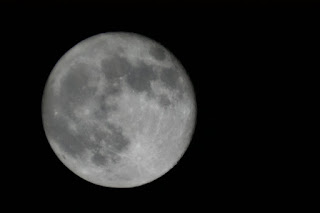
and here's how it looked through the Barlow lens:
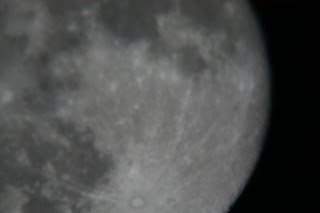
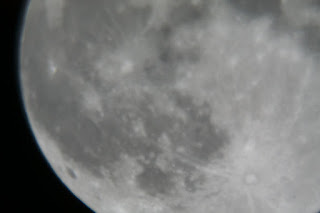
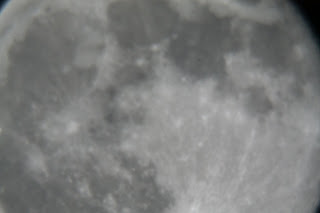

It's magnificent how man has set foot on this natural satellite (God Bless Nasa - if you don't believe in the conspiracy :)). If you think its a conspiracy, watch the Myth-busters episode on proving whether the moon-landing was a hoax.
The moon's diameter is quarter the size of earths. Its mass is 1/81 of the earth's mass. The average distance between the earth and moon is 384403 km. Despite the distance my telescope has succeeded in showing me it like I've never seen before by my naked eye. Truly amazing.
[My telescope is a 127mm Celestron]
I attached the regular 20mm lens and could see the whole moon within the field of view. Then I added the 3x Barlow lens and could see the craters up close and personal. I also tried out the 6.3mm and again got a clear view of the detailed war-like terrain on the face of the moon.
I saw the Tycho crater clearly with its streaks flying out like the spokes of a bicycle wheel. I saw most of the seas (the darker depressions on the surface) and many more craters recording the history of the battered sphere.
After viewing it through the lenses I decided to hook it up to my camera and snap some pix.
Here's what it looked like through the 20mm lens.

and here's how it looked through the Barlow lens:


It's magnificent how man has set foot on this natural satellite (God Bless Nasa - if you don't believe in the conspiracy :)). If you think its a conspiracy, watch the Myth-busters episode on proving whether the moon-landing was a hoax.
The moon's diameter is quarter the size of earths. Its mass is 1/81 of the earth's mass. The average distance between the earth and moon is 384403 km. Despite the distance my telescope has succeeded in showing me it like I've never seen before by my naked eye. Truly amazing.
[My telescope is a 127mm Celestron]
Friday, April 30, 2010
ISS Flies Over
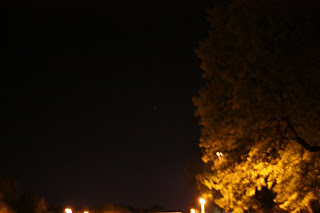
After missing the longer duration fly over of the ISS (International Space Station) yesterday which was publicized via email, I went out today to see it again. It appeared for 2 minutes and rose from the NW and set in the NNE. It looked like a fast moving medium-bright star. I managed to snap one lousy shot of the thing. You can see it in the image below (you have to click on it to see the tiny spec in the center of the image, just to the left of the trees). I posted a cropped zoom in of the white spec.

This is the actual thing (image source: wikipedia):
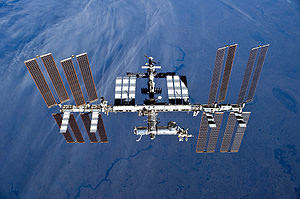
The ISS is a joint project by the US, Europe, Russia and Japan. Other parts have been built by other countries but those space agencies are mostly responsible for the construction which started in 1998 and is scheduled for completion in 2011. It is the largest satellite orbiting Earth and currently there are 6 astronauts living aboard it.


This is the actual thing (image source: wikipedia):

The ISS is a joint project by the US, Europe, Russia and Japan. Other parts have been built by other countries but those space agencies are mostly responsible for the construction which started in 1998 and is scheduled for completion in 2011. It is the largest satellite orbiting Earth and currently there are 6 astronauts living aboard it.
Monday, April 26, 2010
Escape from Planet Doom

Our game design course project is up and live. It's a bullet hell shooter (a specific type of shoot 'em up games) with a twist of comic drama.
Try it out (Escape from Planet Doom) and let me know what you think. Use w-a-s-d keys for moving your ship and move the mouse to aim. Beware of the drama ;)!
Here are some snapshots:


Sunday, April 18, 2010
King of Kong
"King of Kong: A fistful of quarters", a documentary about the best of the best in classic arcade video games. The story is about the rivalry between Billy Mitchell and Steve Wiebe over conquering the high score position of Donkey Kong :D.
If you dont want me to spoil it, dont read any further and read it after you watch it...
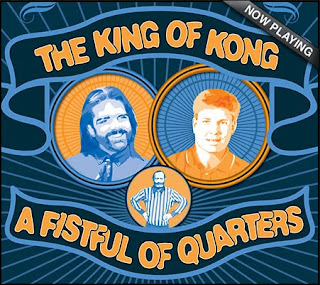
Billy Michell was the first gamer to get a perfect score in pacman and has been known as "the greatest arcade video gamer of all time". He owns a restaurant and sells a line of hot sauces :). He's quite a unique individual. Steve Weibe, on the other hand is a high school teacher who challenged Billy to Donkey Kong. He also held the record for Donkey Kong Junior but Mark Kiehl stole the title back just yesterday (April 19, 2010).
What the drama of the documentary does not show is that the current high scorer is a third guy - a 35 year old plastic surgeon from new york - Dr. Hank Chien who recorded his score via DVD just last month (April 8th). It also does not show that Billy stole back the position after Weibe took it in 2007.
Just watch it...
If you dont want me to spoil it, dont read any further and read it after you watch it...

Billy Michell was the first gamer to get a perfect score in pacman and has been known as "the greatest arcade video gamer of all time". He owns a restaurant and sells a line of hot sauces :). He's quite a unique individual. Steve Weibe, on the other hand is a high school teacher who challenged Billy to Donkey Kong. He also held the record for Donkey Kong Junior but Mark Kiehl stole the title back just yesterday (April 19, 2010).
What the drama of the documentary does not show is that the current high scorer is a third guy - a 35 year old plastic surgeon from new york - Dr. Hank Chien who recorded his score via DVD just last month (April 8th). It also does not show that Billy stole back the position after Weibe took it in 2007.
Just watch it...
Saturday, April 17, 2010
Color Harmony
Do all colors go together?
Obviously not, there are contrasting colors, colors that match and colors that don't match. There are primary colors, secondary colors, tertiary colors and many more hues and levels of saturation. Color theory has long set out to find colors that work well together and appear to be in harmony. Color theory can be traced back to the 15th century with the works in principles of colors by Leonardo Da vinci and Leon Battista Alberti. Sir Isaac Newton started the tradition of color theory with his theories on primary colors in the 18th century.
The color wheel can be traced back to the 18th century. Boutet's color circle/wheel can be seen below. This was drawn in 1708. It depicts hues of primary, secondary, tertiary and complementing colors.

As time passed the color wheel got more detailed. The one sketched below was created in 1908.

From this color wheel, harmonic color schemes can be composed. Here I describe the basic color schemes:
- The monochromatic classic scheme is one that is based on levels of saturation and brightness of a single hue. An example of this is the grayscale which I've seen in games and looks exceedingly soothing.
- An analogous color scheme focuses on colors that are adjacent to one another on the color wheel. Only a limited number of hues are selected.
- A complementary scheme involves colors on opposite sides of the color wheel.
- A split complement color scheme takes an analogous color scheme and adds to it the complementary analogous scheme on the opposite side of the color wheel.
- The triadic takes three analogous color schemes and puts them together so that they form a mercades benz kind of symbol over the color wheel. This can be seen below.
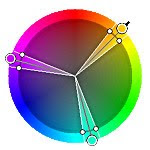
- In addition to these color schemes, there is also the double complementary scheme or tetradic scheme which is similar to the previous one but involves a pair of split complementary schemes over the wheel.
For a more detailed description of these as well as the pros and cons and tips on using each, visit this link.
It is very important to pick your colors, saturation and contrasts well and iterate over your color schemes. The more you experiment and get feedback from others, the more you master this art of producing harmonious color schemes. Color schemes also depend on the art style that you are coloring. Some color schemes go well with certain art styles and badly with others, so think, visualize and iterate.
Obviously not, there are contrasting colors, colors that match and colors that don't match. There are primary colors, secondary colors, tertiary colors and many more hues and levels of saturation. Color theory has long set out to find colors that work well together and appear to be in harmony. Color theory can be traced back to the 15th century with the works in principles of colors by Leonardo Da vinci and Leon Battista Alberti. Sir Isaac Newton started the tradition of color theory with his theories on primary colors in the 18th century.
The color wheel can be traced back to the 18th century. Boutet's color circle/wheel can be seen below. This was drawn in 1708. It depicts hues of primary, secondary, tertiary and complementing colors.

As time passed the color wheel got more detailed. The one sketched below was created in 1908.

From this color wheel, harmonic color schemes can be composed. Here I describe the basic color schemes:
- The monochromatic classic scheme is one that is based on levels of saturation and brightness of a single hue. An example of this is the grayscale which I've seen in games and looks exceedingly soothing.
- An analogous color scheme focuses on colors that are adjacent to one another on the color wheel. Only a limited number of hues are selected.
- A complementary scheme involves colors on opposite sides of the color wheel.
- A split complement color scheme takes an analogous color scheme and adds to it the complementary analogous scheme on the opposite side of the color wheel.
- The triadic takes three analogous color schemes and puts them together so that they form a mercades benz kind of symbol over the color wheel. This can be seen below.

- In addition to these color schemes, there is also the double complementary scheme or tetradic scheme which is similar to the previous one but involves a pair of split complementary schemes over the wheel.
For a more detailed description of these as well as the pros and cons and tips on using each, visit this link.
It is very important to pick your colors, saturation and contrasts well and iterate over your color schemes. The more you experiment and get feedback from others, the more you master this art of producing harmonious color schemes. Color schemes also depend on the art style that you are coloring. Some color schemes go well with certain art styles and badly with others, so think, visualize and iterate.
Thursday, April 15, 2010
Revolutionary Learning
What youtube has brought us is way more than hilarious moments that break the monotonous cycle of work and viral videos out of control. It has brought about a revolution in learning. Now the lucky bastards of the younger generations can tap into this immense resource of knowledge and information right under their fingertips.
I cant get over the power of learning through visual means. Those of us who thrive on imaginary visuals thought up in the chambers of our brains that allow us to comprehend new things, find youtube and the like an amazing source for learning new things. Things we never thought possible a few years ago.

The days without internet were not long ago for those like me who can still remember the days when the term "Internet" started spawning off the tongues of friends more well-read than I. I can remember the first time I heard it. I couldn't comprehend it.
Anyway, nostalgia aside, say we wanted to learn a song on the guitar. Back in the day, I was lucky enough to be learning during the internet phase but before youtube had matured. I used to read tabs off the net, print them out and study them hard. Nowadays a simple search on youtube will show you a person playing the guitar and playing the song that you want to know how to play and chances are you'll find a visual tutorial on how to play it.
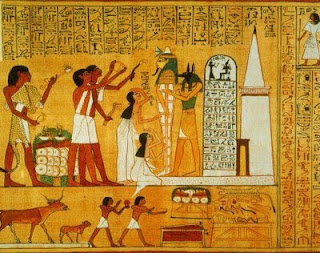
The power of visualizing something has been inscribed in the history of man, for example, the ancient Egyptians conveyed detailed stories of the afterlife in vivid pictures. The steps a man goes through as he is judged before the Gods, is carved out and painted on walls of tombs and temples for the people to see and visualize what happens in the afterlife. Vision is the most powerful sense people have. It is the most perceiving of our senses.
It goes without saying, that the ability to record visuals and transmit them over the internet is an amazing capability. For example, I took a course in linear algebra and found videos from Professor Strang at MIT. In them, he explained linear algebra in a simple way. This was extremely beneficial. I was not physically present in the classroom but could see what was going on. The alternative would be to filter through books on the subject and write up notes or something.
So I'm happy to be witnessing this powerful means of conveying knowledge and thought I would share this with you.
I cant get over the power of learning through visual means. Those of us who thrive on imaginary visuals thought up in the chambers of our brains that allow us to comprehend new things, find youtube and the like an amazing source for learning new things. Things we never thought possible a few years ago.

The days without internet were not long ago for those like me who can still remember the days when the term "Internet" started spawning off the tongues of friends more well-read than I. I can remember the first time I heard it. I couldn't comprehend it.
Anyway, nostalgia aside, say we wanted to learn a song on the guitar. Back in the day, I was lucky enough to be learning during the internet phase but before youtube had matured. I used to read tabs off the net, print them out and study them hard. Nowadays a simple search on youtube will show you a person playing the guitar and playing the song that you want to know how to play and chances are you'll find a visual tutorial on how to play it.
The power of visualizing something has been inscribed in the history of man, for example, the ancient Egyptians conveyed detailed stories of the afterlife in vivid pictures. The steps a man goes through as he is judged before the Gods, is carved out and painted on walls of tombs and temples for the people to see and visualize what happens in the afterlife. Vision is the most powerful sense people have. It is the most perceiving of our senses.

It goes without saying, that the ability to record visuals and transmit them over the internet is an amazing capability. For example, I took a course in linear algebra and found videos from Professor Strang at MIT. In them, he explained linear algebra in a simple way. This was extremely beneficial. I was not physically present in the classroom but could see what was going on. The alternative would be to filter through books on the subject and write up notes or something.
So I'm happy to be witnessing this powerful means of conveying knowledge and thought I would share this with you.
Monday, March 29, 2010
Augmented Reality
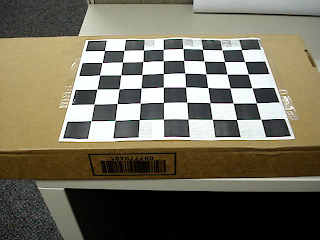
Recently I had a computer vision assignment that was loads of fun. The assignment was on calibrating a camera based on images of a calibration grid (checkered board shown below) from different angles.
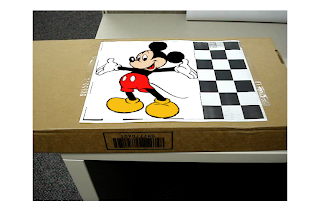
Once the calibration was done using linear algebra we were able to project clipart images onto the calibration grid. This is the same as the projected advertisements you see on football fields on TV.
Then we augmented images with 3D structures. The first was a 3D cube which looks like its sitting on the calibration grid. Its a bit hard to see the outline of the cube in the image below, so you may want to click on it to view it enlarged. The second is a 3D mesh object which is projected onto the grid.
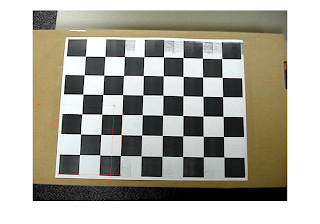

zoomed in...


Once the calibration was done using linear algebra we were able to project clipart images onto the calibration grid. This is the same as the projected advertisements you see on football fields on TV.

Then we augmented images with 3D structures. The first was a 3D cube which looks like its sitting on the calibration grid. Its a bit hard to see the outline of the cube in the image below, so you may want to click on it to view it enlarged. The second is a 3D mesh object which is projected onto the grid.


zoomed in...

Sunday, October 18, 2009
End of The World
I stumbled upon a webpage totally and utterly by accident today. I typed in "goo" and hit enter before I could finish typing google :S.
A page popped up. It was a wikipedia page with the title: "Grey goo". It didn't seem interesting at all. It seemed like one of those useless entries you ignore. Out of curiosity I read the first sentence. It caught my attention!. It read: Grey goo "is a hypothetical end-of-the-world scenario involving molecular nanotechnology in which out-of-control self-replicating robots consume all matter on Earth while building more of themselves — a scenario known as ecophagy ("eating the environment")" :S What the ****!!!??? Visions from the movie, "The Day the Earth Stood Still", started flowing through my mind...
So its a term coined by Eric Drexler in his 1986 book Engines of Creation in which he talks about tiny atom-size machines and the uses of such machines in our lives. Interesting stuff...
Friday, July 31, 2009
Circadian Rhythm - The "Biological Clock"
The Circadian Rhythm is what we call informally - the "biological clock". This rhythm is a roughly-24-hour cycle in the biochemical, physiological or behavioral processes of living entities. Circadian rhythms are generated from within living organisms and can be synchronized by external events, called Zeitgebers. The primary Zeitgebers is daylight. These rhythms allow organisms to anticipate and prepare for precise and regular environmental changes.

The main biological clock in mammals is located in part of the brain (the suprachiasmatic nucleus - SCN). Destruction of the SCN results in the complete absence of a regular sleep/wake rhythm. The SCN receives information about illumination through the eyes. The retina of the eyes contains not only photoreceptors but also photoresponsive cells. These cells, which contain a photo pigment are linked to the SCN. If cells from the SCN are removed and cultured, they maintain their own rhythm in the absence of external triggers (interesting!). It appears that the SCN takes the information on day length from the retina, interprets it, and passes it on to the pineal gland. In response the pineal secretes the hormone melatonin. Secretion of melatonin peaks at night and recedes during the day.
There are many health problems associated with disturbances of the human circadian rhythm. Disruption to the rhythm usually has a negative effect. Many travelers have experienced the condition known as jet lag, with its associated symptoms of fatigue, disorientation and insomnia. A number of other disorders are associated with irregular functioning of circadian rhythms. Disruption to rhythms in the longer term is believed to have significant adverse health consequences on peripheral organs outside the brain, particularly in the development or exacerbation of cardiovascular disease. The suppression of melatonin production associated with the disruption of the circadian rhythm may increase the risk of developing cancer.
NB: A number of studies have concluded that a short period of sleep during the day, a power-nap, does not have any effect on normal circadian rhythm, but can decrease stress and improve productivity.
[Source: http://en.wikipedia.org/wiki/Circadian_rhythm#Origin]
Saturday, March 21, 2009
Savant Syndrome & Extraordinary People
Savant syndrome is not a recognized medical diagnosis but researchers define it as a rare case where a person has developmental disorders but has one or more areas of expertise, abilities or brilliance.
A well-known case is Kim Peek the real person behind the character played by Dustin Hoffman in the film Rain Man. Around 50% of savants are autistic and the other half suffer from various disorders. Kim Peek is a savant but is not autistic. He has a photographic memory and can read a book in about an hour (speed reading) and remember about 98.7% of everything he has read. He can recall the content of 12,000 books from memory :D. He is also a natural calculator. The fame he received due to being the "real rain man" has improved his social skills.
There are other well-known savants including writers and musicians. Some people develop their abilities later in life as a result of an accident, illness or trauma. Alonzo Clemons was a normal boy until he suffered brain damage as a result of a fall. After that he could build accurate animal sculptures from clay using his photographic memory. Some scientists believe the potential to become a genius is actually in all people but is hidden by normal functioning intellect. Savants suffer from damage to the brain which disrupts normal functioning and allows the brain to access these hidden skills.
There are some extraordinary people out there. I saw some documentaries about these people. A young boy who lost his eyesight due to disease could actually "see" using sound waves. A man that can survive unbelievably cold temperatures. A woman that can see sound in the form of color ribbons. Rudiger Gamm is a mental calculator who gained his amazing ability at the age of 21. He can calculate complex math in his head. He can also speak complete sentences backwards :D. He can also calculate calenders and has proved mathematic theories due to his remarkable ability. Rudiger Gamm gained his ability almost overnight as he was reading a book of numbers which had a table of the powers of numbers. He says that anyone can do what he does, "There is just a table of numbers to learn then anyone can do it". His case was examined and he was not classified as a savant but rather as a case of genetics. You can see a clip about him here. You'll find more links to extraordinary people from there.
This is interesting stuff!
Friday, March 20, 2009
Types of Intelligence
Psychologist Howard Gardner proposed a "theory of multiple intelligences" to more accurately define the concept of intelligence and to address whether techniques of measuring intelligence were scientifically sound.
He classified intelligence into the following:
1. Bodily-kinesthetic (intelligence linked to physical activities)
2. Interpersonal (intelligence in interaction with others)
3. Verbal-linguistic (spoken and writing intelligence)
4. Logical-mathematical (intelligence in logic, abstractions, reasoning and numbers)
5. Naturalistic (nature, nurture and relating info to one's natural surroundings)
6. Intrapersonal (introspective and self-reflective capacity)
7. Visual-spatial (visual and spatial judgment)
8. Musical (intelligence in rhythm, music and hearing)
The classification was originally seven but Gardner later added an eighth (Naturalistic intelligence).
Gardner also suggested and explored other intelligences including spiritual, existential and moral but excluded them from the classification because they overlapped with the 8 above and were hard to determine compared to the other intelligences.

So which is your strongest intelligence?
Full article: here
Thursday, February 19, 2009
Facebook Withdraws New Terms
Facebook, after much opposition, has reverted its terms to the old one prior to the recent changes. Thank goodness!
See the previous post for information regarding the changes Facebook made to its terms of service.
See the previous post for information regarding the changes Facebook made to its terms of service.
Wednesday, February 18, 2009
Facebook Owns You
I just heard the news that Facebook has updated its terms of service.
Now it claims that it owns or at least shares your uploaded content!!!
It gives them the right to use and sublicense your uploaded content in anyway they see fit (though they claim fairplay!) even after you "delete" anything. They can use your photos in ads for example. They can use your name, image and likeness for commercial purposes and advertisement.

Of course a reaction has been boiling up against this change. 80,000+ users joined a group protesting these new terms ("People Against the new Terms of Service (TOS)"). What happened to Facebook! It is no longer the little innocent startup; they have transformed into another evil empire :S. They even hold the right to use content you have deleted from their network!!!!! This is outrageous! The other social networks are not like this. Twitter has no intellectual right to your content. Myspace can use your non-private content for myspace services only and this right is deleted with the deletion of the content. Youtube also claims a limited license to your uploaded videos and this halts after deletion.
This is an insidious move by Facebook!
For a detailed description, visit here
Saturday, January 24, 2009
Indians in Space (Chandrayaan)
October of last year, India sent up its first space mission. It sent up Chandrayaan-1 which consisted of a lunar orbiter and an impacter. The impacter separated from the orbiter and hit the surface of the moon releasing debris which was analyzed for water/ice. The orbiter will map the surface of the moon. Already images of the deep moon craters have been beamed back.

India has become the fourth country after the US, Russia and Japan to put its flag on the moon. This is quite an achievement. It shows that India is a force to be reckoned with. In the 1960s American products were boosted by the US missions into space. The missions were seen as a sign of technological advancement in all aspects, not just space flight. Japan visited the moon in 1990, China sent probes up into lunar orbit and now India successfully completes its first event in the exploration of our moon. This definitely gives a boost to Indian technology. They have already developed the worlds cheapest car. Despite the enormous poverty they are on the right track in the technological sector.

India has become the fourth country after the US, Russia and Japan to put its flag on the moon. This is quite an achievement. It shows that India is a force to be reckoned with. In the 1960s American products were boosted by the US missions into space. The missions were seen as a sign of technological advancement in all aspects, not just space flight. Japan visited the moon in 1990, China sent probes up into lunar orbit and now India successfully completes its first event in the exploration of our moon. This definitely gives a boost to Indian technology. They have already developed the worlds cheapest car. Despite the enormous poverty they are on the right track in the technological sector.
Thursday, November 20, 2008
Ghandi's Seven Evils
Mahatma Gandhi's wisdom on "Traits Most Spiritually Perilous to Humanity"
Wealth Without Work
Pleasure Without Conscience
Science Without Humanity
Knowledge Without Character
Politics Without Principal
Commerce Without Morality
Worship Without Sacrifice
Wow, very intense words. If you think about them you'll find that they are indeed true.
Wealth Without Work
Pleasure Without Conscience
Science Without Humanity
Knowledge Without Character
Politics Without Principal
Commerce Without Morality
Worship Without Sacrifice
Wow, very intense words. If you think about them you'll find that they are indeed true.
Saturday, October 11, 2008
One Heck of a Documentary!
Just finished watching part II of "When We Left Earth: The NASA Missions". It was utterly breathtaking to watch every minute of it. I still haven't watched part III but definitely look forward to it.

Anyone with interest in space, technology and scientific success stories would find this documentary childishly spell-binding.
My advise -> Get it & watch it!
It shows that inspiration, aspiration, perspiration and determination can make wonders.

Anyone with interest in space, technology and scientific success stories would find this documentary childishly spell-binding.
My advise -> Get it & watch it!
It shows that inspiration, aspiration, perspiration and determination can make wonders.
Saturday, August 09, 2008
Monday, June 02, 2008
Computer Vision Vs. Image Processing
Computer vision is different to image processing.
Image processing tends to focus on 2D images. It look at how to transform one image to another by pixel-wise operations such as contrast enhancement, local operations such as edge extraction or noise removal, or geometrical transformations such as rotating the image. This characterization implies that image processing neither require assumptions nor produce interpretations about the image content. Computer vision tends to focus on the 3D scene projected onto one or several images, e.g., how to reconstruct structure or other information about the 3D scene from one or several images. Computer vision often relies on more or less complex assumptions about the scene depicted in an image.
Image processing tends to focus on 2D images. It look at how to transform one image to another by pixel-wise operations such as contrast enhancement, local operations such as edge extraction or noise removal, or geometrical transformations such as rotating the image. This characterization implies that image processing neither require assumptions nor produce interpretations about the image content. Computer vision tends to focus on the 3D scene projected onto one or several images, e.g., how to reconstruct structure or other information about the 3D scene from one or several images. Computer vision often relies on more or less complex assumptions about the scene depicted in an image.
Wednesday, May 07, 2008
Obama!
If I was an american, I would support Obama all the way. Naturally I would hate to see another Republican president after the disastrous Bush junior.
All the same, this US presidential election is very different. It has the oldest contender, the first female runner and the first African American candidate. For the first time I've found myself obsessed with the US campaign trail. I remember I was also into the Bush I vs. Clinton I and then Al Gore vs. Bush II. I remember the happiness when there were false claims that Al Gore had won over the controversy that took place in Florida state. I remember the sadness as Bush II won again and went on to another period of being the worst president in the history of the US.
Just this morning North Carolina was declared an Obama state by a large margin of 56 to 42 percent. In the Indy primary unfortunately Obama lost by a narrow 2 percent.
Obama's origin, character and of course his policies are what makes him different. He is the son of a Kenyan man and a white American. He is exceedingly charismatic - "Yes we can!" :). His speeches were turned into clips on youtube and music videos. I've never seen a presidential candidate speak like I saw Obama speak after the first incident with his former reverend. He speaks down to earth and charismatically feels like the basketball coach down the road...hehe.

He opposes war. He wants to open dialogs with foreign countries. He is active in the international arena. His health care policies is beneficial for the US people - "I believe that the millions of Americans who can't take their children to a doctor when they get sick have that right...". He has foresight in the energy crisis with his energy & environment plans. His policies should increase investments in infrastructure, energy independence, education and R&D. He also wants to modernize and simplify taxation and implement trade policies that benefit the US and also increase the export of American goods.
I think he should be the next US president. He'll cleanup the rubbish of his predecessor. If you think otherwise, let me know...
Subscribe to:
Posts (Atom)